Ever since I first saw him as Lex Luthor in Superman, Gene Hackman has been one of my favorite actors. As my movie tastes and knowledge expanded, I discovered The French Connection and The Conversation, which only deepened my appreciation for his range. I was thrilled when he started appearing in films of my generation—Jerry Bruckheimer and Tony Scott’s Enemy of the State and Crimson Tide, as well as David Mamet’s Heist. And then there’s the brilliant “Caine-Hackman Theory” from PCU, which posits that at any given time, somewhere on TV, there’s either a Michael Caine or Gene Hackman movie playing.
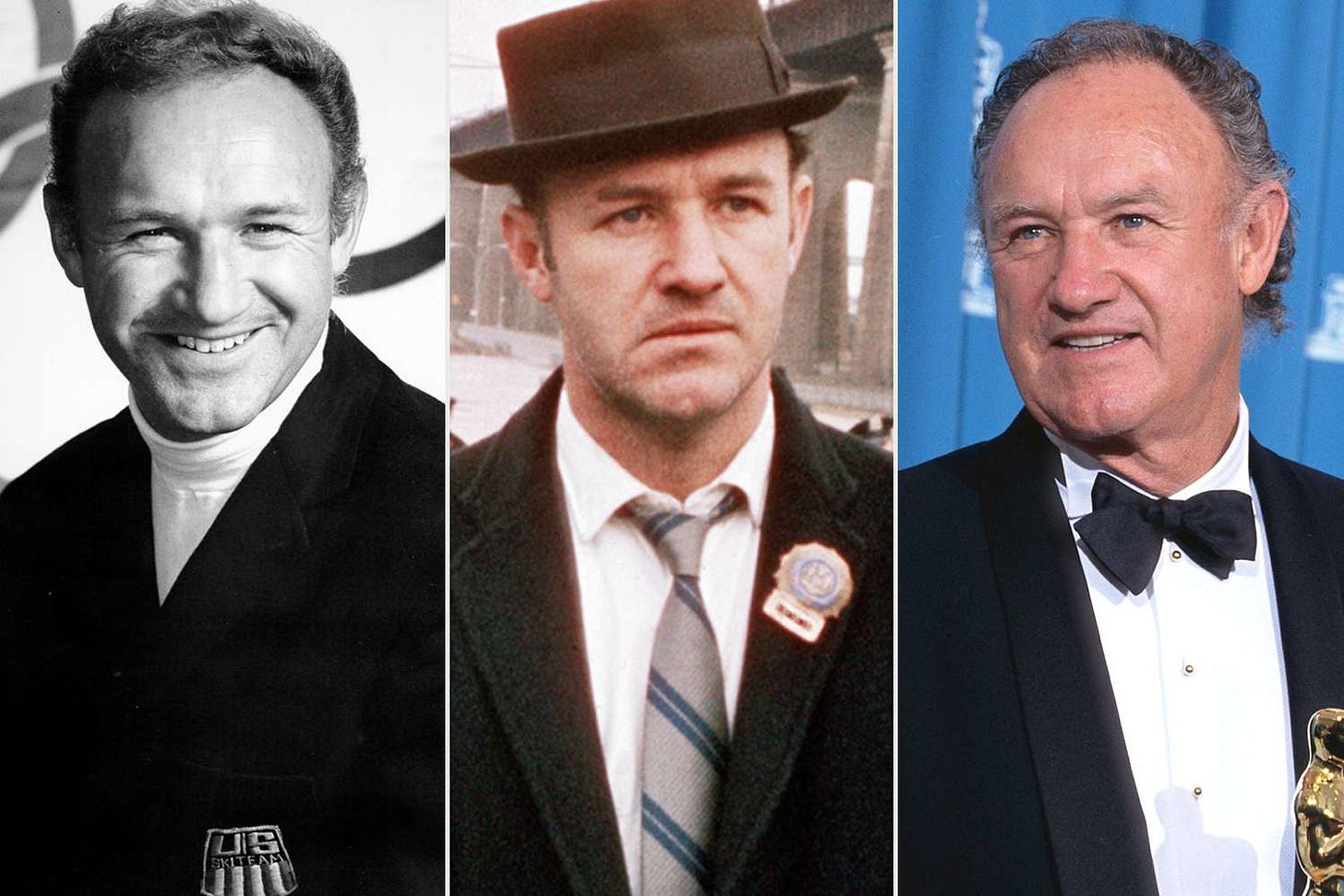
I recently read that it’s been over twenty years since Hackman’s last film, which startled me at first. That’s the power of movies in the streaming age: we can watch our old favorites any time we like, preserving these actors in a kind of digital amber. Hackman remains that actor for me—timeless, compelling, and forever part of my cinematic DNA.
So, in tribute to one of the screen greats, here is my Movie Life Lesson
Gene Hackman and “Having Faith in "The Poseidon Adventure”.
Ever see a ‘70s disaster flick and think, “Wow, this might be the most religious movie of all time?”
Probably not—but it’s time to give The Poseidon Adventure a fresh look.
Yes, Irwin Allen’s 1972 disaster epic isn’t usually lumped in with faith-based classics like The Passion of the Christ, Noah, or The Ten Commandments. Still, The Poseidon Adventure has a spiritual core that deserves more attention. It’s about belief—both in God and in yourself—and how adversity forces us to wrestle with our deepest convictions. In other words, it’s a flood story on steroids, complete with biblical echoes, personal sacrifice, and profound lessons about human resilience.
Setting Sail: The Premise
Producer Irwin Allen, often called “The Master of Disaster,” made a career out of big-budget spectacles like The Poseidon Adventure and The Towering Inferno. Together with Airport (1970), these films launched the modern disaster genre—huge ensembles, massive explosions, and elaborate special effects. Because the spectacle is so overwhelming, audiences often miss the deeper theme pulsing below deck: faith in the face of catastrophe.
The story begins aboard the S.S. Poseidon, where a New Year’s Eve party is in full swing. We meet a star-studded cast of characters:
Reverend Scott (Gene Hackman), a radical preacher sent halfway around the world for his unorthodox beliefs.
Mike Rogo (Ernest Borgnine), a New York detective on his first real vacation, and his wife Linda (Stella Stevens), a former hooker who’s trying to move beyond her past.
Belle and Manny Rosen (Shelley Winters and Jack Albertson), an older Jewish couple heading to Israel to meet the grandson they’ve never seen.
Acres, the Irish bartender played by Roddy McDowall.
Robin and Susan, two siblings traveling together, and Mr. Martin (Red Buttons), a quirky single guy with an unforgettable speed-walking habit.
Leslie Nielsen appears (in a pre-comedy era) as the ship’s weary captain, whose final voyage is beset by ominous weather and the demands of ship owners.
Then, in a classic Irwin Allen set piece, the camera cuts between the festive ballroom and the bridge, where an undersea earthquake triggers a rogue wave. In a matter of moments, everything flips—literally.


When the World Turns Upside Down
The colossal wave hits, and the Poseidon capsizes. Passengers, tables, even pianos tumble in every direction as the ceiling becomes the floor. The lights go out. People are crushed under debris. It’s chaos. When the dust settles, the survivors realize they’re stuck inside an upside-down vessel rapidly taking on water.
How would you react if your world suddenly flipped? Lose a job? Get blindsided by a global pandemic? Face a major loss you never saw coming? That’s your rogue wave. And it might leave you wondering: Do I just wait for rescue, or do I climb for my life?
Faith vs. Authority
In the midst of the panic, we see two contrasting forces:
The Purser, urging everyone to stay put and pray for help.
Reverend Scott, insisting they move now or drown.
Scott is no conventional preacher. He believes God wants us to act: “Don’t pray to God to save you,” he says. “Pray to that part of God within you—and have the guts to fight for yourself.” Essentially, divine intervention works in tandem with personal responsibility.
Some choose to follow the Purser’s advice, hoping external salvation will come. Others climb with Scott, choosing action over passivity. In a brilliantly symbolic scene, the survivors scramble up a toppled Christmas tree (yes, a Christmas tree saves them) to reach higher ground. It’s a literal and metaphorical leap of faith.
Going Through Hell to Find Heaven
To escape, they must navigate flooded corridors, fiery passages, and precarious ladders that highlight each character’s fears. Belle Rosen worries she’s too heavy to climb, Nadia’s claustrophobia flares in a cramped air duct, and Linda’s pushy façade hides a deep vulnerability. Yet, as they face these trials, they also grow closer, relying on one another for survival.
This “ascent” feels like traveling through the circles of hell—fires rage, water rushes in, and more than one character sacrifices themselves so the group can move on. The Poseidon Adventure might be a big-budget popcorn flick, but there’s real depth in the way it portrays community, courage, and compassion under extreme stress.
Sacrifice and Revelation
One of the most heartbreaking moments comes when Belle Rosen (Shelley Winters)—a “fat lady on land, but a skinny lady in the water”—swims heroically to save Reverend Scott from drowning. She succeeds, only to succumb to a heart attack. Before dying, she gives Scott her chai necklace (the Hebrew symbol for life), reminding him—and us—that life “always matters very much.” Her final act of selflessness brings Scott to his knees in a raw, desperate prayer: “Not this woman.”
In a single scene, the film lays bare its spiritual heartbeat: To save one life is to save the whole world. Faith, love, and self-sacrifice are intrinsically linked. Scott—who’d been preaching self-reliance—now begs God to spare Belle. It’s an Old Testament wrestling match, a Jacob-vs.-the-Angel moment, where a mere mortal howls at the heavens in anguish and fury.

Confronting God in the Chaos
As they near the final obstacles—fire, exploding steam valves, narrow walkways—people are pushed to their limits. Mike Rogo loses his wife, Linda, and crumbles in despair. Scott hurls himself across a chasm to shut off a scalding valve, screaming at God for “fighting against us!” It’s another raw confrontation with the divine. He can’t abide a God who won’t help. But he also knows there’s no turning back.
In the end, Scott literally hangs over the abyss, using his last strength to save the others. Then he falls into the flames below, sacrificing himself in one final leap of faith. Mike Rogo, newly awakened to this strange blend of grit and grace, leads the survivors to the engine room, where they bang on the hull until rescuers appear.
Why Do Bad Things Happen to Good People?
Whether you chalk it up to divine will, free will, or sheer chance, The Poseidon Adventure suggests that true faith emerges in the face of catastrophe. If life were always easy, we’d never need to believe in anything beyond ourselves. Scott’s philosophy is clear: God won’t do the work for you, but if you trust in both a higher power and your own ability to act, you might just find a way through.
The survivors are ultimately rescued—only those who moved with Scott. Everyone else, waiting in the ballroom, didn’t make it.
Rogue Waves and Leaps of Faith
So, what’s your rogue wave? A global crisis? A sudden layoff? A personal tragedy you never saw coming? The question The Poseidon Adventure poses is whether you’ll sit and wait—or muster the will to climb.
Just as Scott demanded a literal leap from Susan at the start of the film, ask yourself: What leaps of faith have you taken in your life? What furniture did you have to “burn” so you wouldn’t freeze? Where did you find the strength to keep climbing, even when fear screamed at you to stand still?
Final Thoughts
There’s a reason The Poseidon Adventure remains a landmark film. Sure, it’s got that classic ‘70s glitz, but it also grapples with timeless questions about responsibility, faith, and the sacrifices we make for one another. It says if you’re going to pray, pray to the part of God within you that inspires action—and don’t be afraid to wrestle with the Almighty if things get rough. But, if you want to survive life’s challenges, you can’t sit and wait. You have to move. You have to climb. And when the moment comes, you have to jump.
May you have the faith to keep climbing, the courage to leap when you must, and the awareness to help others do the same. Because in the end, those leaps of faith—big or small—are what keep us afloat when the world turns upside down. May you have success in all your endeavors. And when the time comes—may you take the leap.