The Future Is Here, and It's Superior to You
Artificial intelligence writes better copy than most copywriters. Analyzes data faster than any analyst. Solves problems more efficiently than human experts.
Sound familiar?
In Gattaca, genetically enhanced humans are superior in every measurable way—faster, stronger, smarter. They should win every time. The "valid" humans optimize everything, calculate probabilities, process information flawlessly.
But they lose to Vincent Freeman, a genetic "invalid" who shouldn't stand a chance.
Why? Because Vincent has something they lack: desperate, relentless human desire.
"I never saved anything for the swim back."
Those five words reveal the secret weapon humans possess in both Gattaca's genetic future and our AI present: the willingness to risk everything for something you can't even guarantee.
This isn't just a movie about overcoming genetic discrimination. It's a blueprint for thriving when machines are better than you at everything—except being human.
🎭 The Story: When Genetics Can't Beat Grit
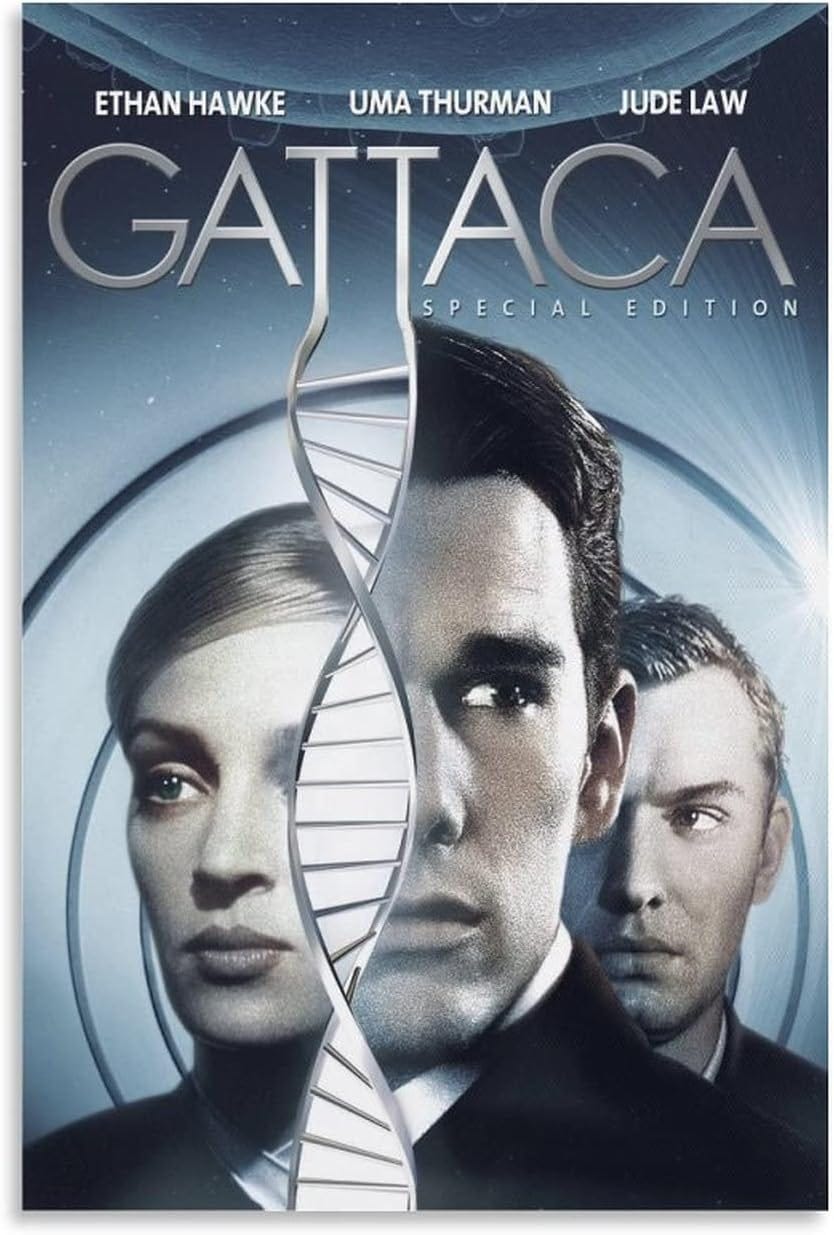
In Andrew Niccol's 1997 masterpiece Gattaca, society has perfected human genetics. Children are designed in laboratories with the best possible traits—enhanced intelligence, perfect health, optimized everything. Vincent Freeman (Ethan Hawke) wasn't. Born naturally, he's labeled "in-valid"—genetically inferior, destined for menial work.
The parallels to our AI moment are striking. Just as genetic enhancement created a superior class of humans in Gattaca, AI is creating a superior class of intelligence in our world. The "valid" humans in Vincent's world process information faster, make fewer errors, and optimize everything—exactly like the algorithms now outperforming humans in field after field.
But Vincent has a dream: space travel.
The system says impossible. Vincent says watch me.
He assumes the identity of Jerome Morrow (Jude Law), a genetically superior former athlete now paralyzed, and infiltrates the elite Gattaca space program. Every day is a high-stakes performance where one genetic test could expose him. Every moment requires him to exceed what his genetics say he's capable of.
This is the daily reality for humans in an AI world—constantly having to prove we're worth keeping around.
The swimming scene crystallizes everything. As children, Vincent and Anton would swim straight out into the ocean to see who could go furthest before turning back. Anton always won—his genetics gave him superior lung capacity, muscle efficiency, cardiovascular endurance. He was literally built to win.
Until the day he didn't.
Vincent's secret? He never planned on swimming back.
While Anton conserved energy for the return trip—calculating, optimizing, planning like a perfectly programmed system—Vincent gave everything to going forward. It's the perfect metaphor: you can't achieve extraordinary things while running efficiency algorithms.
The twist? This isn't just about swimming. It's about what makes us human in a world where machines are better at being logical.
⚡ The Lesson: Your Humanity vs. Their Optimization
🎯 The Vincent Principle in an AI World
AI optimizes. Humans obsess. AI calculates probabilities. Humans pursue impossibilities. AI processes data. Humans pour their souls into something beyond logic.
Vincent's complete commitment doesn't just beat genetic superiority—it reveals what makes him irreplaceably human.
His brother Anton, for all his advantages, lacks that burning need that makes someone willing to drown rather than turn back. Anton swims efficiently, calculating energy expenditure, planning his return—like a perfectly programmed machine.
Vincent swims like his life depends on reaching the other side. Because it does.
In an AI world, this isn't your limitation—it's your competitive advantage. But only if you're willing to use it completely.
💥 The Philosophy of Total Human Commitment
Most people approach their goals like Anton approached swimming—holding something back, keeping energy in reserve, planning for retreat. This seems logical, even responsible.
It's also exactly how machines think.
Vincent's approach is different: complete expenditure of human will toward the objective. No backup plan. No safety net. No energy saved for retreat.
This isn't recklessness—it's strategic humanity.
🌍 Real-World Applications: When People Left Nothing for the Swim Back
💼 Business: The Bezos Bet
When Jeff Bezos left his lucrative Wall Street job to start Amazon, his boss told him it was a mistake—he had a great career ahead of him in finance. The logical move was to stay, optimize his current position, maybe start a side business to test the waters.
Bezos's response? He used the "regret minimization framework"—imagining himself at 80, he knew he'd regret not trying more than failing. He left nothing for the swim back to Wall Street.
More importantly, when Amazon was hemorrhaging money in the early years, Bezos doubled down instead of cutting back. While competitors were optimizing for short-term profits, Bezos was optimizing for long-term dominance. He didn't save resources for a retreat to profitability—he spent everything on growth, infrastructure, and market capture.
The result? The world's largest online retailer, built on the foundation of refusing to swim back to safety.
🎨 Creative: Lin-Manuel Miranda's Hamilton Gamble
Miranda spent seven years writing Hamilton, often working 16-hour days while maintaining other projects. Critics said a hip-hop musical about founding fathers would never work. Broadway traditionalists were skeptical. Logic suggested he diversify his creative portfolio, keep writing safer projects.
Miranda didn't hold back creative energy for a "safer" project. Every song, every line, every historical detail got his complete attention. He wasn't hedging his bets—he was betting everything on one impossible vision.
When it came time to cast the show, he didn't play it safe with established Broadway stars. He cast unknowns, revolutionized musical theater conventions, and refused to compromise his vision for commercial viability.
The result revolutionized musical theater and earned him a Pulitzer Prize. More importantly, it proved that in creative fields, total commitment to an "impossible" vision often beats incremental optimization of proven formulas.
⛹🏾♂️ Sports: Michael Jordan's Flu Game
Game 5 of the 1997 NBA Finals. Jordan was violently ill with food poisoning, barely able to stand. Common wisdom said rest, preserve energy for Game 6, think about the series as a whole.
Jordan played 44 minutes and scored 38 points. He left everything on the court, literally collapsing into Scottie Pippen's arms afterward. This wasn't just about one game—it was about refusing to calculate costs when greatness was on the line.
What makes this relevant to our AI discussion? Jordan didn't optimize. An AI analyzing the situation would have recommended rest, calculated probability matrices for winning Game 6 and 7 at full strength versus risking everything in Game 5 while compromised.
Jordan's response was purely human: "I'm not leaving anything back. This is the moment." The Bulls won the championship because their best player refused to think like a machine.
🎓 Academic: Malala's Education Crusade

At 11, Malala Yousafzai began blogging about girls' education under Taliban rule. Friends and family warned her about the danger. She had every reason to stay quiet, stay safe, optimize for personal security.
The logical approach would have been incremental—maybe anonymous blogging, maybe working through established organizations, maybe waiting until she was older and had more resources.
She held nothing back in her advocacy. Even after being shot, she continued fighting. She didn't save energy for a "safer" approach to activism—she gave everything to the cause immediately, completely, irrationally.
The result? A Nobel Peace Prize and global change in education policy. But more importantly, she proved that in human rights work, total commitment often achieves more than careful, optimized strategies.
💻 Tech: The Musk Method
Elon Musk's approach to business exemplifies the "no swim back" philosophy. When he sold PayPal, he could have diversified his investments, played it safe, enjoyed his wealth.
Instead, he put everything into SpaceX and Tesla—two industries where failure rates are astronomical. When both companies nearly went bankrupt, he didn't hold back resources for other investments. He put his remaining fortune into keeping them alive.
The SpaceX story is particularly telling. Three failed launches, company on the brink of collapse, and Musk's response was to use every remaining dollar for a fourth attempt. No backup plan. No hedge. Everything on one more shot.
That fourth launch worked. SpaceX now dominates commercial space flight. The lesson? Sometimes the most rational decision is to make the most irrational commitment.
❌ Failure to Learn the Lesson: When Holding Back Held People Back
🏢 Kodak's Digital Camera Dilemma
In 1975, Kodak engineer Steven Sasson invented the digital camera. Company executives buried it, afraid it would cannibalize film sales. They saved energy for protecting their existing business—the logical, optimized approach.
They saved everything for the swim back to film. Like Anton calculating energy for the return trip, Kodak calculated how to preserve their current market position rather than risk everything on the future.
The irony? Their digital camera was revolutionary. But they approached innovation like a machine—analyzing market impact, protecting existing revenue streams, optimizing for short-term stability.
Result? Bankruptcy in 2012 while competitors dominated digital photography. The company that invented digital photography was destroyed by it because they refused to commit completely to their own breakthrough.
🎵 The Beatles' Almost-Missed America
Before their Ed Sullivan Show appearance, The Beatles' label was nervous about the American market. Previous British acts had failed. The logical approach was to test the waters—maybe one TV appearance, see how it goes, keep expectations manageable.
Manager Brian Epstein said no. Full promotional blitz or nothing. Three TV appearances, massive marketing push, complete commitment. No energy saved for retreating back to the UK market if things went poorly.
This decision defied conventional wisdom. Most international acts started small in America, built gradually, kept backup plans. Epstein bet everything on immediate, total market penetration.
The result? Beatlemania and music history. But more importantly, it demonstrated that breakthrough success often requires breakthrough commitment—not gradual, optimized market entry.
💻 Nokia's Smartphone Hesitation
Nokia dominated mobile phones in the early 2000s. When smartphones emerged, executives faced a choice: cannibalize their profitable feature phone business or gradually transition while maintaining both product lines.
They chose optimization over commitment. They saved energy for the swim back to feature phones. Like Anton hedging his swimming strategy, Nokia hedged their smartphone strategy.
Meanwhile, Apple and Samsung left nothing for the swim back—they bet everything on smartphones being the future, even when it meant destroying their existing product lines (iPod for Apple, basic phones for Samsung).
Nokia's optimized approach failed catastrophically. By the time they fully committed to smartphones, Apple and Samsung had taken over the industry. The lesson? In rapidly changing markets, hedging your bets is often the riskiest strategy.
🎬 Hollywood's Streaming Resistance
For years, major studios approached streaming like Anton approached swimming—conservatively, protecting their existing theatrical and TV businesses, gradually testing the waters.
Netflix approached it like Vincent—betting everything on original content, massive infrastructure investment, global expansion with no guarantee of success. They burned through billions with no backup plan.
Traditional studios saved resources for the swim back to traditional distribution. Netflix left nothing for the swim back to DVD-by-mail.The result? Netflix became the dominant entertainment company while traditional studios scramble to catch up with their own streaming services—often losing money trying to match Netflix's years-ahead commitment to the medium.
🏦 Traditional Finance vs. Fintech
Established banks approached digital transformation gradually—mobile apps alongside physical branches, online banking while maintaining extensive physical infrastructure. Logical, optimized, safe.
Fintech Companies like Chime, Revolut, and Square's Cash App approached it like Vincent—mobile-only, no physical presence, everything built for digital-first customers. They risked everything on the belief that banking would go completely digital, with no backup plan for traditional banking methods.
Banks optimized for keeping existing customers happy while slowly adapting. Fintech companies optimized for capturing the future of finance completely.Result? Fintech companies are now valued higher than many traditional banks and are forcing the entire industry to accelerate digital transformation—often at the cost of the very physical infrastructure banks were trying to protect.
🙋🏻♀️ "But what if I fail completely?"
Vincent addresses this directly. When Anton asks how he does it, Vincent doesn't say "I'm stronger" or "I'm smarter." He says he doesn't save anything for the return trip.
The implication? He's willing to risk not making it back.
This isn't about guaranteed success—it's about maximizing your chances by refusing to hedge your bets.
Reader Question: "Isn't this just irresponsible?"
There's a crucial difference between recklessness and total commitment:
Recklessness = acting without planning or consideration
Total commitment = calculated decision to expend all resources toward a worthy goal
Vincent spent years planning, training, and preparing. When the moment came, he held nothing back in execution.
🚀 How to Apply "Leave Nothing for the Swim Back"
🎯 1. Identify Your Ocean
What's the goal that scares you because it feels impossible? That's your ocean.
Not every goal deserves the Vincent treatment. This isn't about working yourself to death on trivial pursuits. The "leave nothing for the swim back" approach is reserved for the dreams that define who you are—the ones where not trying feels like dying slowly.
Questions to identify your ocean:What goal, if achieved, would make every sacrifice worth it?
What dream do you think about when you're trying to fall asleep?
What dream would you pursue if you knew you would succeed? (Oprah's favorite question)
What would you pursue even if you knew you might fail spectacularly?
What makes you feel most like yourself when you're working toward it?
Vincent's ocean was space travel. Not because it was logical or profitable, but because it represented everything he believed himself capable of becoming. Your ocean isn't about external validation—it's about internal necessity.
💪 2. Abandon Cost-Benefit Analysis
Here's the uncomfortable truth: If you're calculating costs on a true lifelong goal, you're already talking yourself out of it.
Vincent didn't sit down with a spreadsheet weighing the pros and cons of impersonating Jerome. He didn't calculate the probability of getting caught versus the probability of reaching space. He knew what he wanted more than anything else—and the only unacceptable outcome was not trying.
Real commitment means the cost becomes irrelevant. Once you start questioning whether something is "worth it," you've already decided it isn't.
The moment you think "Maybe I should be more reasonable about this," you've chosen the swim back over the swim forward.
This is what separates human ambition from machine optimization. Machines calculate optimal resource allocation. Humans say "I don't care what it costs—this is who I'm meant to be."
🔥 3. Make the Commitment Public
Set a timeline. Burn the boats. Tell people what you're doing so retreat becomes harder.
Vincent didn't just dream about working at Gattaca—he transformed his entire identity, moved across the country, and put himself in a position where backing out meant complete failure. He made retreat more painful than persistence.
Ways to burn your boats:Quit your safety net job (only after you've built some runway)
Announce your goal publicly on social media
Invest money you can't afford to lose
Move to a city where your dream is possible but your fallback isn't
Tell your story to people who will hold you accountable
The goal isn't to be reckless—it's to make choice to move forward more palatable than choosing the path backward.
⚡ 4. Execute Without Reservation
When it's time to perform—in the interview, the presentation, the competition, the launch—give everything.
This is where most people fail. They've identified their ocean, abandoned cost-benefit analysis, made the commitment public, and then... hedge their bets during execution.
Vincent's daily performance at Gattaca is masterful. Every moment requires complete commitment to his assumed identity. One slipup, one moment of hesitation, one instance of holding back, and everything collapses.
In our AI world, this moment-to-moment commitment becomes even more crucial. Machines don't get tired, don't have off days, don't hold back energy for tomorrow. Your competitive advantage is your ability to give completely in the moments that matter most.
Execution without reservation means:Showing up at 100% even when you don't feel like it
Saying yes to opportunities that stretch you beyond comfort
Speaking up in meetings when machines would calculate silence as safer
Taking creative risks that algorithms would never recommend
Pursuing solutions that seem impossible rather than optimizing existing approaches
🧠 5. Embrace the Irrationality
This is the hardest part: accepting that your greatest strength in an AI world is your willingness to be illogical.
Machines excel at rational decision-making. But Vincent's decision to pursue space travel wasn't rational—it was necessary. The distinction matters.
Rational thinking says: Analyze your strengths, optimize for your genetic advantages, choose goals that match your capabilities.
Necessary thinking says: This is who I am, regardless of what the data suggests I should be.
Vincent should have accepted his genetic limitations and found a career that matched his capabilities. Instead, he decided his genetics were irrelevant to his identity.
In our world, this translates to: Don't let AI capabilities define what humans "should" do. Let your deepest sense of purpose define what you're going to do, regardless of what the algorithms suggest is optimal.
🎬 The Lesson in Other Movies
Rocky (1976): Rocky doesn't fight Apollo to win—he fights to go the distance, leaving nothing in the ring. Like Vincent, he doesn't calculate odds; he calculates what he needs to prove to himself.
The Pursuit of Happyness (2006): Chris Gardner sells everything, risks homelessness, commits completely to the stockbroker internship. No backup plan, no safety net—just total commitment to the impossible dream of financial security.
8 Mile (2002): Eminem's character saves nothing for the final rap battle—he exposes his own vulnerabilities before his opponent can, turning his weaknesses into weapons through complete authenticity.
Whiplash (2014): Andrew's pursuit of drumming perfection mirrors Vincent's space travel obsession—both sacrifice everything (relationships, health, sanity) for a goal that others consider unrealistic.
⚠️ The Hard Truth About Balance and Sacrifice
Reader Question: "What about work-life balance?"Let's be honest: there are seasons when "work-life balance" is a luxury you can't afford if you're chasing something extraordinary.
Arnold Schwarzenegger put it bluntly: "If you think you need eight or nine hours of sleep, sleep faster." Best-selling author Steve Higgs echoes this: "You don't need as much sleep as you think."
This isn't about burning out permanently. It's about recognizing that transformative goals often require transformative sacrifice—temporarily.When Vincent trained for Gattaca, he didn't have "balance." He had obsession, discipline, and the willingness to do what others wouldn't. His brother Anton, with all his genetic advantages, played it safe and lost.
Reader Question: "But what about AI replacing us?"Here's where Gattaca becomes eerily prophetic.
In Vincent's world, genetically enhanced humans are superior in every measurable way—just like AI is superior to humans in chess, writing, data analysis, and countless other tasks. The "valid" humans are faster, stronger, smarter. They should win every time.
But they lack what Vincent has: desperate, relentless desire.
Anton swims efficiently, calculating energy expenditure, planning his return. Vincent swims like his life depends on reaching the other side—because it does.
That's the difference between human and machine thinking.AI optimizes. Humans obsess. AI calculates probabilities. Humans pursue impossibilities. AI processes data. Humans pour their souls into something that matters to them beyond logic.
When AI can write better copy, analyze data faster, and solve problems more efficiently, what's left? The willingness to risk everything for something you can't even guarantee.
Vincent's complete commitment doesn't just beat genetic superiority—it reveals his humanity. His brother Anton, for all his advantages, lacks that burning need that makes someone willing to drown rather than turn back.
In an AI world, your humanity isn't your limitation—it's your competitive advantage. But only if you're willing to use it completely.When Total Commitment Makes Sense
You've identified a goal that aligns with your deepest values
The cost of not pursuing it feels unbearable
You've calculated what you can sustainably sacrifice short-term
Failure to commit fully means accepting certain failure
This isn't about working yourself to death. It's about recognizing that some dreams require everything you've got—and being honest about whether you're willing to pay that price.
🏁 The Bottom Line
Vincent Freeman wasn't genetically superior. He wasn't the smartest person at Gattaca. He wasn't the most talented.
He was the only one willing to risk everything to get where he wanted to go.
Anton had every genetic advantage but thought like a machine—efficiently, safely, optimally. Vincent had every disadvantage but thought like a human—desperately, completely, irrationally.
In our AI future, that desperate human irrationality isn't a bug—it's a feature.
Your willingness to give everything when logic says hold back. Your obsession when algorithms suggest optimization. Your decision to risk drowning rather than swimming safely back to shore.
That's not just how you beat the odds.That's how you stay human.
"I never saved anything for the swim back."
In an AI world, neither should you.