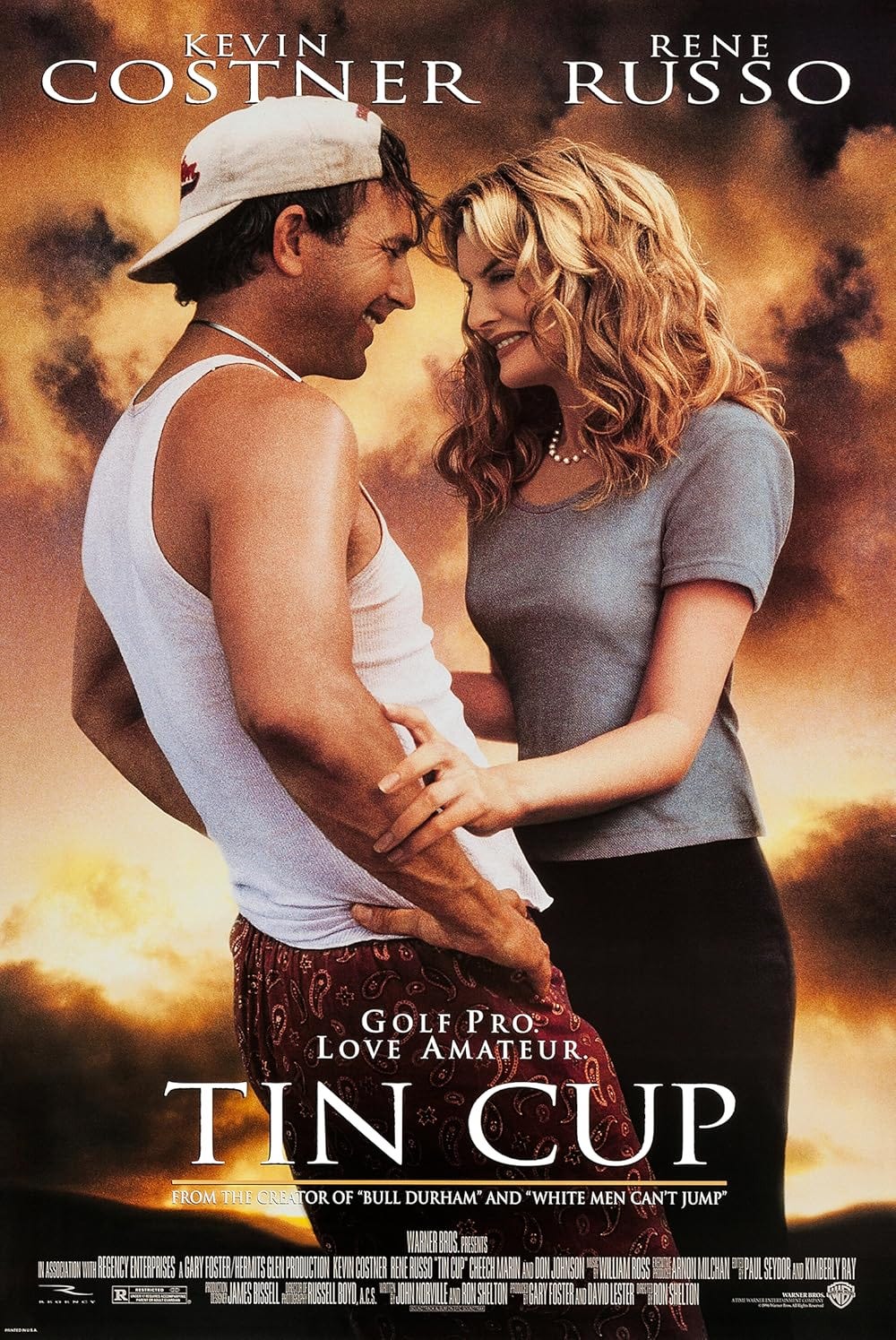
There’s a moment in Tin Cup where Roy McAvoy (Kevin Costner) is standing over a shot, wanting to hit his driver and go for the green. His caddy Romeo (Cheech Marin) tells him not to do it. Play it safe. Lay up with a smaller club.
Roy refuses. So Romeo breaks the driver over his knee.
Roy seems to relent. He reaches for a smaller club, like he’s going to do the sensible thing. Then he breaks that club over his knee too.
And then, in a moment of pure stubborn rage, Roy proceeds to break every single club in his bag. Every one. Except the 7-iron.
Now he’s got no choice. He plays the rest of the match with just that one club. And you know what? He qualifies for the U.S. Open.
The lesson isn’t that the 7-iron is magic. The lesson is that once Roy eliminated all his other options—all his excuses about which club was right for which situation—he had to stop theorizing and just play golf.
We love to prepare because preparation feels like work without the risk of failure.
Albert Brooks nailed this in Lost in America. His character decides to start jogging to “find himself.” He goes to a sporting goods store and what should take five minutes turns into a full tactical acquisition mission. He buys the special shoes, the specific shorts, the moisture-wicking shirt, the headband, the stopwatch. He looks like an Olympian.
He gets to the track, runs ten yards, gasps for air, and quits. He spent $300 to run thirty feet.
We see the same delusion in Judd Apatow’s This Is 40. Paul Rudd plays a music producer who goes into business for himself. What is his first move? Does he sign a hit band? Does he produce a hit record?
No. He leases a massive, chic office space and commissions a custom $30,000 neon sign with the company name. He hangs the sign inside the office. His employee mocks him for it, and rightfully so. He is bleeding cash he doesn’t have to look successful to an empty room.
He is optimizing his image before he has secured his survival. He is “playing business” rather than doing business.
It Does Not Gotta Be The Shoes
We have been conditioned to believe that the magic is in the equipment. In the 1980s, Spike Lee’s character Mars Blackman famously badgered Michael Jordan in those iconic Nike commercials, screaming, “Is it the shoes? It’s gotta be the shoes!”
We bought the sneakers because we wanted to fly like Mike.
But here is the hard truth we ignored: It does not gotta be the shoes.
It was never the shoes. It was the thousands of hours Jordan spent in the gym before Mars Blackman ever picked up a camera. The shoes were just packaging.
If you gave Michael Jordan a pair of hiking boots, he would still dunk on you. If you gave Roy McAvoy a garden hoe, he would still find a way to par the hole.
The Core Truth: Busy Work is Just Another Form of Procrastination
Here’s the part nobody likes to admit: Researching is often just a sophisticated way of hiding.
Setting up the perfect desk is not writing.
Buying the domain name is not building the business.
Designing the logo is not getting a customer.
It’s believing we just need the right pen, the right app, or one more weekend seminar before we start. The preparation becomes the shield. Because if you never start, you never risk finding out whether you’re any good.
Real Stories: The Tool Doesn’t Matter
Ray Bradbury wrote his classic Fahrenheit 451 on a rented typewriter in the basement of the UCLA library. He had to feed dimes into it—ten cents for every thirty minutes. He didn’t have time to optimize his process or wait for the muse. The clock was literally ticking. So he wrote.
Thelma Schoonmaker edited Raging Bull on a Moviola—a clunky machine from the 1920s. She won an Oscar. The tool didn’t matter. Her eye mattered.
Shakespeare wrote with a feather. Hemingway wrote sitting down, standing up, or hungover. It’s not the tool that makes the artist. It’s the consistent work at the craft.
The Star Wars Test
There’s a moment in Star Wars where Luke Skywalker is debating the merits of blasters versus lightsabers. He is focused on the weapon. The gear.
Obi-Wan stops him cold. He teaches him that it’s not about the blaster (”clumsy and random”) or even the lightsaber (”an elegant weapon”). It’s about the Force.
It’s about control over himself. The most powerful tool in the galaxy isn’t the hardware; it’s the discipline, presence, and focus of the user.
🎬 THE DIRECTOR’S CUT
Action steps to apply this to your life.
The “7-Iron” Constraint: You are drowning in options. Pick one tool to do your work this week. One notebook. One app. One pair of shoes. Lock everything else in the closet. If Roy McAvoy can qualify for the U.S. Open with a 7-iron, you can write your proposal in Microsoft Word.
The “Zero-Dollar” Greenlight: Impose a spending freeze on your project. You are not allowed to buy a new logo, a new domain, or a new piece of software until you have generated your first dollar or produced your first prototype. If you can’t do it for free, you can’t do it with expensive gear either.
The Bradbury Sprint: Set a timer for 30 minutes right now. Your goal is quantity, not quality. Produce as much as you can before the buzzer. No editing. Just typing.
The Bottom Line
Stop cycling through tools searching for the right one when you haven’t used any of them to do the work. Stop ritualizing the prep stage. Stop buying the neon sign for the business that hasn’t made a dollar.
Grab your 7-iron and play the course.