Paulie: “Don’t listen to ‘em, Rock.”
Apollo: “No. Do listen to them, Rock. When this is over, a lot of folks are going to owe you an engraved apology. And you’re going to owe me a favor.”
-Carl Weathers, Burt Young, and Sylvester Stallone. “Rocky 3”
THE STORY
In Rocky III (1982), Rocky Balboa (Sylvester Stallone) has everything he ever wanted. The title. The money. The fame. But he’s lost the thing that got him there: hunger. He’s been fighting handpicked opponents, doing commercials, living in a mansion. The bum from Philadelphia has become the establishment.
Then Clubber Lang (Mr. T) comes along—a ferocious, undefeated challenger who is everything Rocky used to be: angry, desperate, and dangerous. Lang destroys Rocky. Worse, Mickey (Burgess Meredith), Rocky’s beloved trainer, dies from a heart attack after the fight. Rocky has lost his title, his mentor, and his identity in a single night.
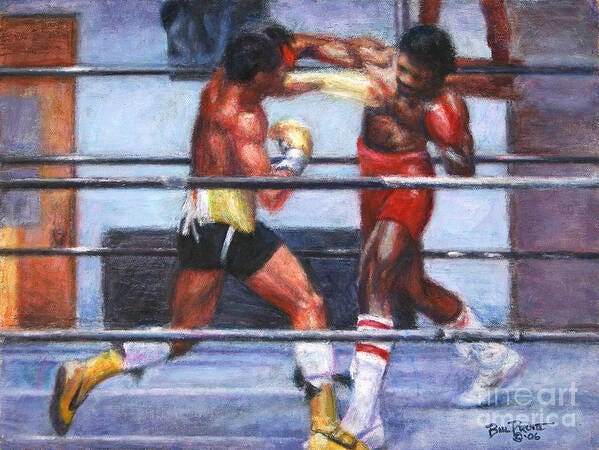
Enter Apollo Creed (Carl Weathers). Rocky’s former rival—the man he fought twice for the heavyweight championship—offers to train him. Not out of charity. Apollo sees something in Rocky that Rocky can’t see in himself. He takes Rocky back to the streets of Los Angeles, strips away the entourage, and retrains him from the ground up.
There’s a pivotal scene during this training period. Rocky, Apollo, and Paulie (Burt Young) are sitting around watching the news. A sports commentator comes on and says that the chances of Rocky repeating as champion at his age are unlikely. The commentator wishes him well—politely writing him off.
Paulie immediately says, “Don’t listen to him.”
But Apollo—a champion, a man who has been where Rocky is trying to go—disagrees. He tells Rocky: “No, do listen to them, Rock. When this is over, a lot of folks are going to owe you an engraved apology...”
And then he adds something we often overlook: “And you’re going to owe me a really big favor.”
Rocky:”What favor”
Apollo: “When it’s over.”
THE LESSON: LISTEN TO THE DOUBTERS
Every motivational speaker on the planet will tell you to block out the haters. Ignore the noise. Put your head down and grind.
Apollo Creed says the opposite. And Apollo is the champion.
Paulie and Apollo represent the living embodiment of that old saying: “Those who say they can and those who say they can’t are both right.” Paulie says it can’t be done. Apollo says it can. And the difference between them isn’t just attitude—it’s identity. Paulie is a loyal guy, but let’s be honest: he’s mediocre. Maybe even a bum. He sees things in terms of impossibility—all the reasons it can’t be done—because he sees the hard work and he’s afraid of it.
Apollo is a champion. He sees things in terms of what can be done because he’s not afraid of the work. He wants Rocky to hear the impossibility. He wants Rocky to take it in, process it, and use it as fuel.
This is the lesson: Don’t block out the doubt. Listen to it. Hear every reason they say it won’t happen. Catalog the obstacles. Then dismantle them, one by one.
THE “HOW” OF LISTENING: PROCESSING VS. REACTING
To understand how to listen and how to tell the difference between somebody whose criticism is simply meant to tear you down, or be a naysayer, versus somebody who is using constructive criticism to build you up, we can look to Rocky’s original trainer, “Mickey” played by the great Burgess Meredith. Mick’s criticism is harsh. It’s sometimes difficult for Rocky to hear. (“You don’t know what to do? After all these years, you don’t know what to do? You oughta be ashamed.”). But it comes from a place of trying to build you up.
Now, there’s a fine line between using doubt as fuel and letting it become a limiting belief. The key is in the processing. You aren’t listening to agree. You’re listening to catalog the obstacles you need to dismantle.
And this is how you recognize the difference between a Paulie and a Mickey or an Apollo.
Think about the “Corporate Paulie.” This is the person in the office who shoots down every new idea because “that’s not how we do things here.” They’re blindly critical for no reason other than their own self-doubts and fears. They want to keep you down (with them) because your success threatens their comfort. They’ll give you a million logical reasons why a project will fail, but really, they’re just protecting their own mediocrity.
Someone in your office who is more like an Apollo or Mickey might tell you straight to your face the reasons why what you’re proposing is going to be difficult, but the critical difference is that a mentor like Mickey or Apollo comes with the steps necessary to make the improvements. They don’t just tell you what’s wrong—they put you through your paces. They provide the training that others don’t understand.
You listen to the Paulies to fuel your grit. But you listen to the Mickeys to find the roadmap.
When you’re in the trenches of the work, that’s when you gain the perspective to see if there was any truth in their criticism. Maybe the haters and doubters were right that it would be hard. Maybe they were right that it would take immense time. The champion processes that information and uses it. The bum lets it paralyze him.
THE APOLOGY PARADOX
There is a crucial component in Rocky III that we often overlook. Apollo tells Rocky: “When this is over, everybody’s going to owe you an apology, and you’re going to owe me a really big favor.”
But, the movie never actually shows the doubters apologizing to Rocky. Even in the sequels, people are always finding reasons to doubt Rocky. All they can see are the odds against him. That’s why we love Rocky, because, we recognize in him the struggle of our own lives, and so we are inspired and uplifted when he is ultimately victorious.
But even in victory, we never see the apology.
That’s because no one ever tells you that you were right.
The apology isn’t a hater coming to you and saying, “I was wrong about you.” The apology is the silence that follows your success. It’s the fact that they eventually have to acknowledge your reality. They might still hate you, but they can no longer deny you. That is the triumph.
Andy Frisella talks about how if you’re doing anything for the validation of other people, you’re doing it wrong. You have to do it for yourself. The irony is that the validation you’re seeking—if and when it comes—isn’t going to come in the form you think. It won’t even arrive until you are so successful that it’s undeniable. And by then, you won’t even care. You’ll be on such a different level that you’ll see life in a completely different way.
In The Wire, there’s a scene where Dominic West’s “Detective Jimmy McNulty is talking to Clark Peters’s “Detective Lester Freamon” praising himself and Lester as “natural police,” and how there are very few people who can do what they do. To which Lester responds very wisely:
“Tell me something, Jimmy. How exactly do you think it all ends? A parade? A gold watch? A shining ‘Jimmy McNulty Day moment,’ when you bring in a case so sweet, everybody gets together and says, ‘Oh shit, he was right all along. We should listen to the man.’ The job will not save you, Jimmy.”
In other words , the validation and applause you think you’re seeking doesn’t happen the way you imagine it. You ultimately figure out that you have to be doing this for something else—a deeper fuel. Tony Robbins calls it your “Must.” Sometimes it’s hard to tap into that real reason because it can be overwhelming, and that’s where the doubters come in. They give you something tangible to push against while you figure out the deeper why.
THE DEBT OF GRATITUDE: PAYING BACK THE FAVOR
We never see the apology. But we do see Rocky paying back the to Apollo. And I think that’s the more important component.
Even the people who doubted you—your haters—are contributive to your ultimate success. They provided the friction. You used their doubt as fuel. But the real debt is to the Apollos and the Mickeys. These are your mentors, your mastermind groups, the people who actually got in the ring with you to train. Just as Rocky pays that favor back, you better be ready to pay that favor back in your own life, whether it’s by paying it forward or by doing something directly for the people who helped you break through.
Success isn’t a solo act. Act accordingly.
THE MENTALITY OF A CHAMPION
Most people are like Paulie: average, getting a little fatter, a little slower, a little older day by day, year by year, And it all starts with their mentality. Apollo is a champion. And Rocky—which is why we love him—is each of us, vacillating between those two identities: being a nobody, a bum, and being a somebody.
People feel guilty for having “nobody” days. But even the champion version of yourself has a Paulie living in your head. The difference is that the champion doesn’t obey Paulie. The champion hears him, acknowledges the fear, and gets back to work.
Arnold Schwarzenegger tells a story in his autobiography about when he first bought land in Southern California. A friend told him all the reasons it wouldn’t work. Arnold said, “Stop talking now. I almost believed you. You almost convinced me. You’re always thinking of all the reasons it wouldn’t work.” He charged ahead anyway. His plans didn’t even work out the way he initially conceived them—the land he planned to develop couldn’t be developed at first. He had to sit on it. But that land became more and more valuable, and eventually, he turned it into one of the biggest commercial developments in Venice Beach. He didn’t doubt it. He had clarity about what he was doing and he focused on it completely.
My friend, Steve Higgs, is one of the biggest-selling indie authors in the world. He breaks all the rules. He was British military, worked a corporate job, but he had a belief in himself. That belief didn’t manifest in other people at the outset. Everyone asked, “Why are you doing this? Why are you wasting your time?” He had to sacrifice. It was hard work. But the fuel for a lot of that was listening to the people who told him he couldn’t do it.
THE LESSON IN OTHER MOVIES
8 Mile (2002)
In the final rap battle, Jimmy “Rabbit” Smith (Eminem) does something brilliant: he takes every insult his opponent could use against him and says it first. He’s poor, he’s white, he lives in a trailer. He doesn’t deny any of it. He absorbs the doubt, owns it, and turns it into ammunition. His opponent is left standing there with nothing to say. When you acknowledge every reason people say you can’t, and you’re still standing, they’ve got nothing left.
Moneyball (2011)
Billy Beane (Brad Pitt) is told by every scout, every coach, and every commentator that his system won’t work. He’s trying to build a competitive baseball team with a fraction of the budget of the New York Yankees. The entire baseball establishment laughs at him. His own manager actively sabotages the plan. Beane doesn’t block out the criticism—he processes it, adjusts, and stays the course. The Oakland A’s go on to set the American League record for consecutive wins. The doubters don’t apologize. They just steal his system.
The Pursuit of Happyness (2006)
Chris Gardner (Will Smith) tells his son, “Don’t ever let somebody tell you that you can’t do something.” But notice that Chris doesn’t say “don’t listen.” He says don’t let them define your reality. Chris heard every doubt—from his wife, from the system, from his own circumstances. He processed it and used it as rocket fuel to outwork every Ivy League intern at Dean Witter.
THE TRANSGRESSION: SEEKING THE APPLAUSE
The transgression is doing it for the validation.
If you’re grinding toward some imaginary moment where all the people who doubted you line up to apologize, you’re going to be disappointed. That’s the Paulie move—doing it for someone else’s approval. You’re outsourcing your motivation to people who don’t care about you.
The validation you’re seeking—if and when it comes—won’t arrive in the form you imagine. It won’t be a parade. It won’t be a standing ovation. And it won’t come until you’re so successful that it’s undeniable. By that point, you’ll be on such a different level that you won’t even need it anymore.
That’s the paradox. The thing you think you’re chasing—their recognition—evaporates the moment you arrive. You’ll be fortunate, because “like attracts like.” Other people who have broken through will want to be around you and feed off your energy, just as you want to feed off theirs. That’s why successful people in all walks of life—no matter their profession—seem to continue to succeed. They’ve moved past the need for applause.
Use doubt as fuel, yes. But don’t make it the destination. The destination is the work itself.
THE DIRECTOR’S CUT: LISTEN LIKE A CHAMPION
1. Build Your Doubter’s File
This week, write down every reason someone has told you—or you’ve told yourself—that your goal is impossible. Don’t flinch from it. “You’re too old.” “The market is saturated.” “You don’t have the credentials.” Put it all on paper. Now, next to each doubt, write one specific action you can take to neutralize it. “You’re too old” becomes “I will outwork every 25-year-old in the room by waking up an hour earlier.” “The market is saturated” becomes “I will find the one angle nobody else is covering.” You’re not ignoring the doubt. You’re processing it into a battle plan.
2. Identify Your Paulies and Your Apollos
Look at the five people closest to you. Who is a Paulie—someone whose criticism is rooted in their own fear and mediocrity? And who is a Mick—someone whose feedback is harsh but comes with a roadmap to improvement? You don’t need to cut the Paulies out of your life. But you do need to stop giving their opinions the weight of a mentor’s. Listen to the Paulies for fuel. Listen to the Micks for direction.
3. Pay the Favor Forward
Rocky paid Apollo back. This week, identify one person who helped you get where you are—a mentor, a friend, a colleague who went to bat for you when they didn’t have to. Reach out to them. Not with a generic “thanks.” Tell them specifically what they did and what it meant. If that person isn’t around anymore, pay the favor forward. Find someone younger or less experienced who’s grinding the way you used to grind, and be their Apollo. Get in the ring with them.
4. Redefine the “Apology”
Stop waiting for someone to say “I was wrong about you.” It’s not coming. Instead, define your own apology moment: a specific, measurable milestone that proves the doubters wrong. “When I close my first deal.” “When I finish the manuscript.” “When I run the full marathon.” That moment—quiet, personal, undeniable—is the only apology you need. And it’s the only one that matters.
THE BOTTOM LINE
For all the people who tell you to block out the haters and ignore the doubters—that’s not really true. You should listen to them. Hear every reason they say it’s not going to happen.
Because when you make it happen—day by day, week by week—you’ll realize that that is the accolade. That is the applause. It’s not a trophy. It’s not a speech. It’s the ability to quiet your doubters by actually doing the thing.
Paulie tells you not to listen because he’s afraid. Apollo tells you to listen because he’s been there. One is protecting you from pain. The other is preparing you for victory.
Be like Apollo.