For years, my commute home to Venice Beach was defined by a specific stretch of Olympic Blvd. Once you pass the 405, the traffic thins, the light turns golden, and you pass a brick building marked “National Typewriter Company.”
To the casual observer, it was a relic. To the industry, it was the “National Museum of Mystery Boxes” — the headquarters of Bad Robot.
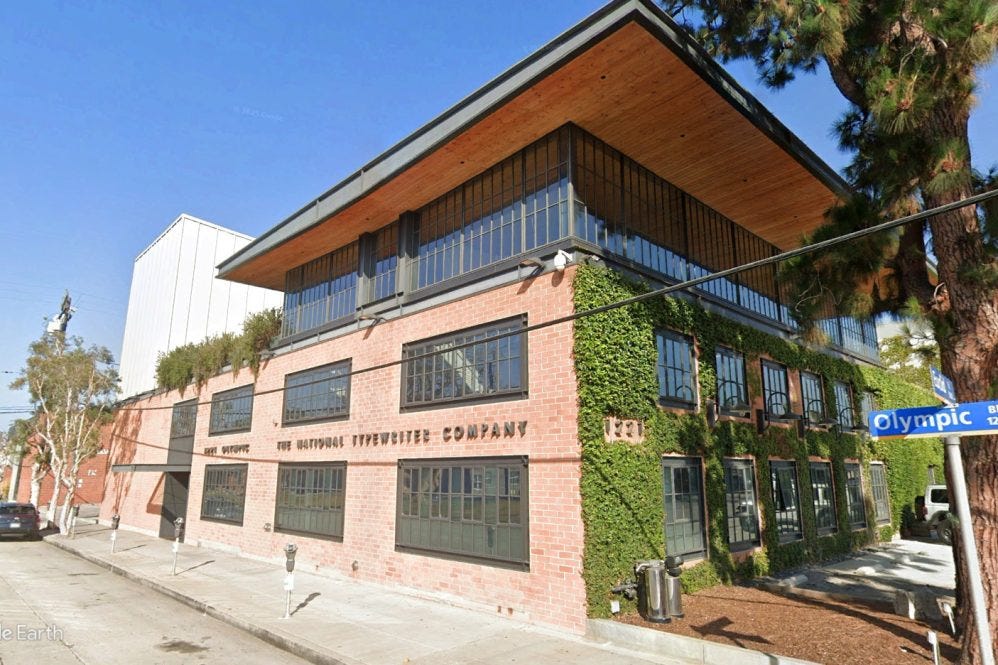
It was a workshop of the soul. I remember developing a TV show there; the interior was a maze of floating staircases, editing suites, and a screening room that felt like the future. In the lobby, 3D printers were constantly churning; creatures JJ had dreamt up at 3 AM were being physically birthed in front of me. It was the embodiment of what Hollywood used to be: a place where the “Big Idea” had a permanent, physical home.
Now, that home is for sale. In fact, it already sold — for $31 million in November of last year — months before the company publicly announced what industry insiders had already seen coming.
🏚️ The Fall of a Giant
In 2019, JJ Abrams signed what was then considered the richest producer deal in modern Hollywood history: a five-year, $250 million overall pact with WarnerMedia. It was designed to rival the machines built around Ryan Murphy, Shonda Rhimes, and Dick Wolf — the showrunner-industrialists of the Peak TV era.
Six years later, the machine has broken down.
In December 2024, that $250M overall deal was quietly downgraded to a modest first-look pact. The Santa Monica headquarters — which once housed hundreds of employees, two theaters, four editing suites, and Kelvin Optical, Bad Robot’s in-house VFX arm — went up for sale. A Justice League Dark series: dead. An Overlook prequel to The Shining: shelved. Duster, the crime drama for HBO: canceled after one season.
And on April 2, 2026 Variety reported that Bad Robot was shuttering its LA office entirely and moving operations to New York.
A top talent agent’s quote in TheWrap summed it up brutally: “They didn’t produce successful stuff and had their deal cut significantly with each new contract until now.”
But this isn’t just about one director. This is about the end of a system.
🚗 The “Detroit-ification” of Los Angeles
Since the early 20th century — when creators fled Edison’s corrupt “Trust” in New York for the freedom of the West — Hollywood has been the gatekeeper. That gate is now off its hinges. And the numbers are staggering:
Los Angeles County has lost 41,000 film and TV jobs in the last three years — a quarter of its entertainment workforce — according to Bureau of Labor Statistics data. The workforce dropped from roughly 142,000 in 2022 to around 100,000 by late 2024.
2025 LA production was about half of what it was in 2019, per FilmLA. Total shoot days fell 16.1% year-over-year to 19,694 in 2025 (down from 23,480 in 2024).
TV drama production in Q4 2025 was 43.3% below the five-year average. TV comedy production was 66% below its five-year average.
Scoring stage bookings dropped from 127 days in 2022 to just 11 days in 2025. Eleven. Days. An entire category of craft — world-class orchestral musicians who scored the movies of our childhood — effectively eliminated.
Only 157 theatrical films, TV shows, and streaming projects shot in LA County were completed and released in 2024. Down from 228 in 2022.
Industry unemployment hit 10.9% in August 2025 — more than double the 4.3% national average.
In a single week in April 2026, Disney announced up to 1,000 layoffs, Sony cut several hundred, and Bad Robot downsized across the board. Over 1,500 jobs gone in seven days.
17,000 entertainment and media jobs were cut across 2025 alone — up 18% over 2024.
This is not a cyclical downturn. This is a structural migration. California now ranks sixth in the world for filming, behind Toronto, the UK, Vancouver, central Europe, and Australia. Between 2020 and 2024, an estimated 71% of projects that failed to secure California’s tax credits moved out of state.
When Detroit lost the auto industry, it didn’t happen in a single year. It happened in a slow, steady hemorrhage that the people living there kept explaining away. Sound familiar?
Why the Stranglehold Is Slipping
1️⃣ The Rise of the Global Creator
I’ve shot in Africa more recently than I’ve shot in LA. Why? Because the “Doyle” — the talented creator willing to do the work — no longer needs to be in Hollywood to make a global impact.
The numbers confirm what I’ve seen with my own eyes:
There are now over 200 million content creators globally.
The global creator economy was valued at $205 billion in 2024 and is projected to hit $1.3 trillion by 2033.
Netflix now has 325 million global subscribers — a number approaching the total population of the United States. Their business strategy is no longer about “making shows for Americans.” It’s about making shows where the audience is.
The number of scripted features and TV projects shooting in the U.S. dropped by 12 percentage points over the last five years, per Luminate.
Even microdramas — those bite-sized vertical video series designed for phones — have built an $8 billion global market in just four years, employing nonunion crews and writers outside the traditional Hollywood ecosystem.
The monopoly on storytelling is over. And once it’s over, it doesn’t come back.
2️⃣ The AI Equalizer
Tyler Perry’s decision to halt an $800 million studio expansion after seeing OpenAI’s Sora was a warning shot heard everywhere except Sacramento. Twelve soundstages. $800 million in planned capital expenditure. Gone. Because Perry, who built an empire outside the traditional LA system, saw what was coming.
“I think it’s going to be a major game changer,” Perry told The Hollywood Reporter, “because if you could spend a fraction of the cost to do a pilot that would’ve cost $15 million, $20 million, or even $35 million… I am very concerned that a lot of jobs are going to be lost.”
He’s already using AI in two of his productions.
Here’s the brutal math: bloated, high-tax California studios carrying union pension obligations, $25/hour mandated minimum wages across service sectors, and a regulatory regime that treats every film shoot like a construction project cannot compete with a lean animator in a low-cost state using a $20/month AI subscription. Feature film production budgets over $40 million dropped nearly 30% in 2024, with another 13% decrease in the first three quarters of 2025. The money that built Hollywood is leaving.
3️⃣ Policy Failure
Sacramento had a chance during the pandemic to rebuild the industry. Instead, they oversaw a period marked by massive deficits, public fraud, and a tax credit program that was one-tenth the size of Georgia’s for most of the collapse.
Governor Newsom finally signed the expansion of California’s Film & Television Tax Credit Program in July 2025 — raising it from $330 million annually to $750 million. The California Film Commission has since allocated $771 million in incentives to dozens of projects, including Jumanji, Heat 2, and Baywatch.
But the damage was done during the years the state sat on its hands. The fourth quarter of 2025 still came in 21.1% below Q4 2024 — after the expansion was signed. And the percentage of incentivized TV production has crept up to only 11.1% of shoot days.
You cannot reforest a clear-cut by planting saplings the day after the bulldozers leave. The infrastructure — the relationships, the suppliers, the crews, the post-production houses, the catering companies, the scoring stages — has already migrated or shuttered.
🌅 The New Possibility Era
This is an inflection point. The “push-pull” between the creators in LA and the money in NY is shifting, and for the first time in a century, neither city holds all the cards.
I lived through Hollywood’s last contraction in 2020-2023. I spent those four years not pitching a single TV show — writing four books instead. The contraction didn’t end my career. It freed it.
The future belongs to the creative entrepreneurs who can bypass the MBAs and the gatekeepers. It belongs to the Tyler Perrys who built in Atlanta. The Taylor Sheridans who built in Texas. The global creators building audiences of millions on a phone in São Paulo, Lagos, or Seoul.
It belongs to anyone willing to pick up the tools — now radically cheaper and more powerful than anything JJ Abrams had access to when he founded Bad Robot in 1999 — and tell a story worth telling.
The sun still sets over the Pacific. But the “National Typewriter Company” sign is coming down.
The “Possibility Era” has moved elsewhere.
And for those of us willing to move with it, the best chapter is just beginning.
📝 Data Sources Integrated:
Bad Robot specifics: Variety (April 2, 2026), Deadline, The Hollywood Reporter, TheWrap — $250M deal, $31M HQ sale, first-look downgrade
FilmLA: 2025 Q4 and full-year production reports (16.1% YoY decline, 19,694 shoot days, TV drama 43.3% below 5-year average)
BLS/LA County jobs: Series Business via Ankler — 41,000 jobs lost, 142K → 100K workforce
Luminate: 24% YoY drop in major scripted productions in LA (Jan 2026 report)
Challenger, Gray & Christmas: 17,000 media/entertainment layoffs in 2025
Tyler Perry: THR, Variety — $800M expansion halt
Creator economy: Market.us, Grand View Research — $205B → $1.3T projection, 200M+ creators
Netflix subscriber count: 325M globally (THR)
Scoring stage data: EUR Web / Guardian reporting
2025 tax credit expansion: California Film Commission — $771M allocated
• • Disney/Sony April 2026 layoffs: Metaintro, Fast Company, Variety